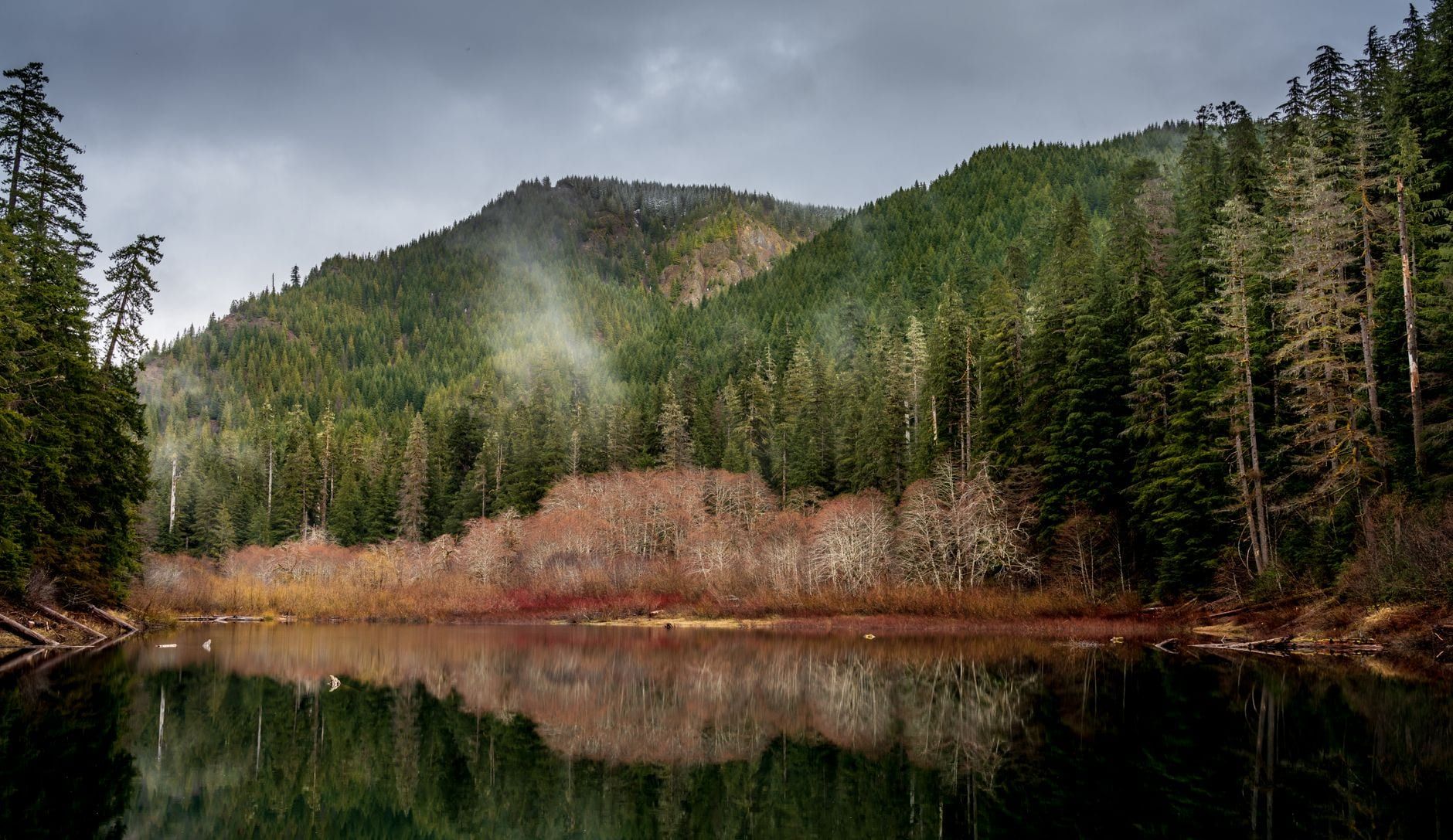
Lake Crescent sits directly on US 101 between Port Angeles and Forks, which makes it the one corner of Olympic National Park you can see without leaving your car — and the one most people leave too quickly. The lake drops 624 feet at its deepest, holds water clear enough to see 60 feet down, and has a trail for every kind of day: a paved rail-trail, a 90-foot waterfall walk, and a quad-burning climb with rope assists. This guide covers the hikes, the water, the lodging, and the logistics, all with official National Park Service trail numbers.
If you're building a wider trip around the lake, our guides to things to do in Olympic National Park and the perfect 3-day Olympic itinerary slot Lake Crescent into a full peninsula loop.
What Makes Lake Crescent Special
Ice did the original work. Huge glaciers gouged a steep valley north of the Olympics, and the basin filled with water so clear it reads as turquoise from the highway above. At 624 feet deep, Lake Crescent is the second deepest lake in Washington, behind only Lake Chelan. Then, roughly 7,000 years ago, a landslide dumped debris across the valley and cut the lake off from its neighbor, Lake Sutherland. The two trout populations stranded on the Crescent side — the Beardslee and the Crescenti — now exist nowhere else on Earth.
The famous clarity has a chemical explanation: the water carries almost no nitrogen, so phytoplankton has little to feed on. In some places you can see 60 feet down, and that transparency plus reflected light produces the blue-green color that stops traffic at every pullout. The lake even influenced a murder investigation — in the decades-old "Lady of the Lake" case, the cold, low-nutrient water preserved the victim's remains and evidence unusually well, a piece of local true-crime lore the lodge staff will happily recount.
People arrived early in the 20th century. Avery and Julia Singer opened Singer's Tavern on Barnes Point in 1914; it evolved into today's Lake Crescent Lodge. On the north shore, the Spruce Railroad was finished in 1919 to haul Sitka spruce for WWI aircraft — the war ended before it ever carried timber, and its rail bed is now the paved trail that runs the length of the shore.
Getting There, Fees & Best Time to Visit
Lake Crescent sits about 18 miles west of Port Angeles on US 101, roughly 30 minutes by car, or about 45 minutes east of Forks. There's no separate entrance station at the lake itself — you pay the park fee ($30 per vehicle, valid 7 days) at any staffed gate, and an America the Beautiful pass covers it. Full details on costs are in our hours and fees guide, and route options from Seattle — ferry or I-5 — are covered in how to get to Olympic National Park.
Late spring through early September is when everything runs: the lodge, the boat rentals, the campground store, the ranger station. Parking at the popular trailheads fills by mid-morning in July and August, so either arrive early or come after 4 pm. Early fall trades some services for thinner crowds and the bigleaf maples turning yellow along the shore — a fair swap if you don't need a kayak. Winter keeps the lake gorgeous but strips it to pullouts and trails. For month-by-month detail, see our best time to visit Olympic National Park.
Two practical warnings. US 101 along the lake is curvy and feels narrow with oncoming traffic; if you're driving an RV, use the pullouts to let cars pass and take the shore sections slowly. And cell service around the lake is spotty to nonexistent — download offline maps, trail info, and current park alerts before you leave Port Angeles or Forks.
The Best Hikes at Lake Crescent
Eight day hikes leave from the lake's shores, from a flat interpretive loop to 4,000-foot climbs. The stats below are the official NPS figures — several popular blogs publish inflated mileage for Mount Storm King (often "4.2 miles") and the Spruce Railroad Trail ("11.2 miles"), which don't match the park's own numbers. For more options beyond the lake, see our guide to the best hikes in Olympic National Park.
| Trail | Distance (one way) | Elevation gain | The short version |
|---|---|---|---|
| Marymere Falls | 0.9 mi | 400 ft | Old-growth walk to a 90-ft waterfall |
| Moments in Time | 0.6 mi loop | Essentially flat | Accessible lakeside loop near the lodge |
| Spruce Railroad Trail | 4.0 mi | ~100 ft | Paved rail bed; bikes and leashed dogs allowed |
| Mount Storm King | 2.2 mi | 2,000 ft | Steep switchbacks, ropes near the top |
| Pyramid Peak | 3.5 mi | 2,600 ft | Climb to a WWII spotting tower |
Marymere Falls
The family pick. A 0.9-mile walk one way through old-growth forest gains just 400 feet and ends at a 90-foot ribbon of water dropping into a mossy alcove. Kids and casual walkers manage it fine; serious hikers can be back at the car in under two hours. The trail shares its trailhead with Mount Storm King at the Storm King Ranger Station parking area off US 101, with alternate access from Lake Crescent Lodge.
Mount Storm King
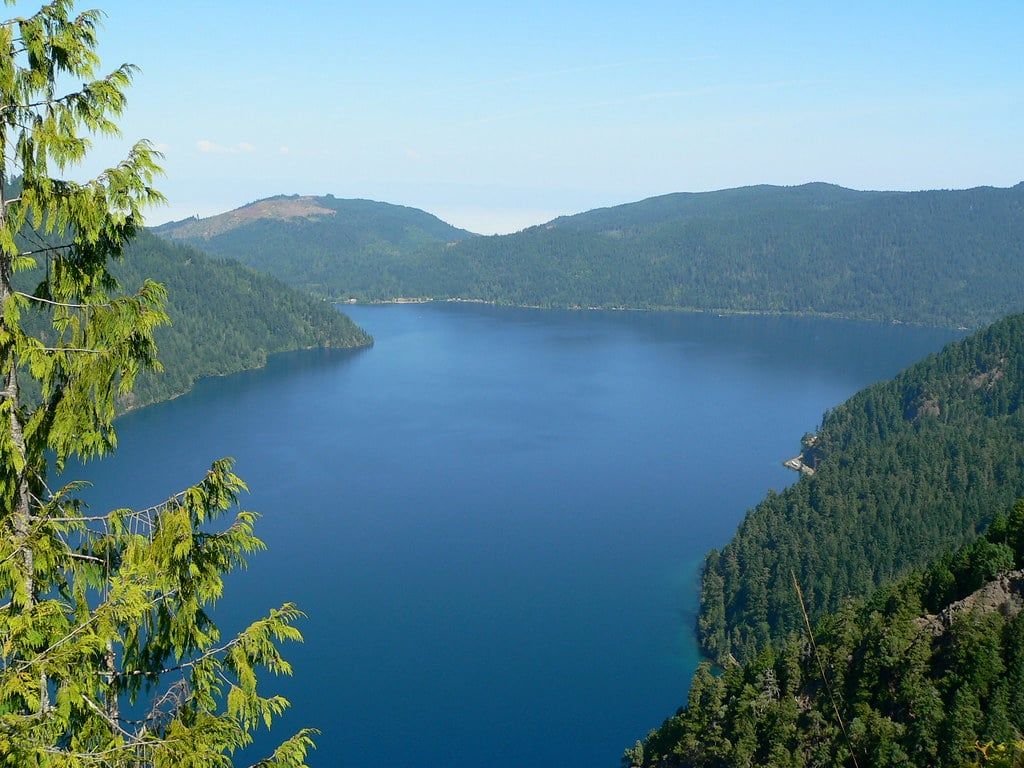
The lake's signature climb and its signature workout: 2.2 miles one way with 2,000 feet of gain, almost all of it on unrelenting switchbacks through forest that finally breaks open onto a rocky viewpoint above the water. Near the top, a sign marks the end of the maintained trail — beyond it, a rope-assisted scramble continues at the hiker's own risk, and the park does not maintain it. Most people should turn around at the sign; the view from there already justifies the climb. If you're splitting up a group, Marymere Falls and this trail share a trailhead, so one half can stroll to the falls while the other slogs up the mountain.
The mountain has a story attached. In Klallam legend, a mountain spirit hurled a boulder that dammed the river and created the lake during a great battle. The geologists' version — the landslide that split one large lake into Crescent and Sutherland about 7,000 years ago — is the one supported by the record, but the Klallam name for the peak came first.
Spruce Railroad Trail
The only trail at the lake open to bikes and leashed dogs, and the flattest. This paved path follows the 1919 railroad bed 4.0 miles one way along the north shore, passing two historic tunnels and gaining only about 100 feet. Bikes and strollers roll it easily, and the 6.5-mile Olympic Discovery Trail extension continues toward Port Angeles if you want mileage. About 2.4 miles round trip from the trailhead, a side path drops to Devil's Punchbowl, a deep turquoise pool wedged between rock walls — the lake's most famous swim hole.
Moments in Time
A 0.6-mile self-guided loop near Lake Crescent Lodge that threads old-growth trees and the shoreline, essentially flat and accessible with assistance. If you have 30 minutes and no ambition, this is the walk — and it ends close enough to the lodge porch to justify a coffee afterward.
The Harder Climbs
Three trails here punish and reward in roughly equal measure, and most guides skip them. Pyramid Peak climbs 3.5 miles one way and 2,600 feet to a WWII aircraft-spotting tower with the best lake panorama outside of Storm King. Aurora Creek gains 3,220 feet in 3.4 miles — that's steeper than Storm King, sustained. Barnes Creek runs 7.5 miles with 4,200 feet of gain, and only the first 4 miles are maintained. Do any of these and you'll earn solitude that Marymere Falls never gives you.
On the Water: Kayaking, Boating & Swimming
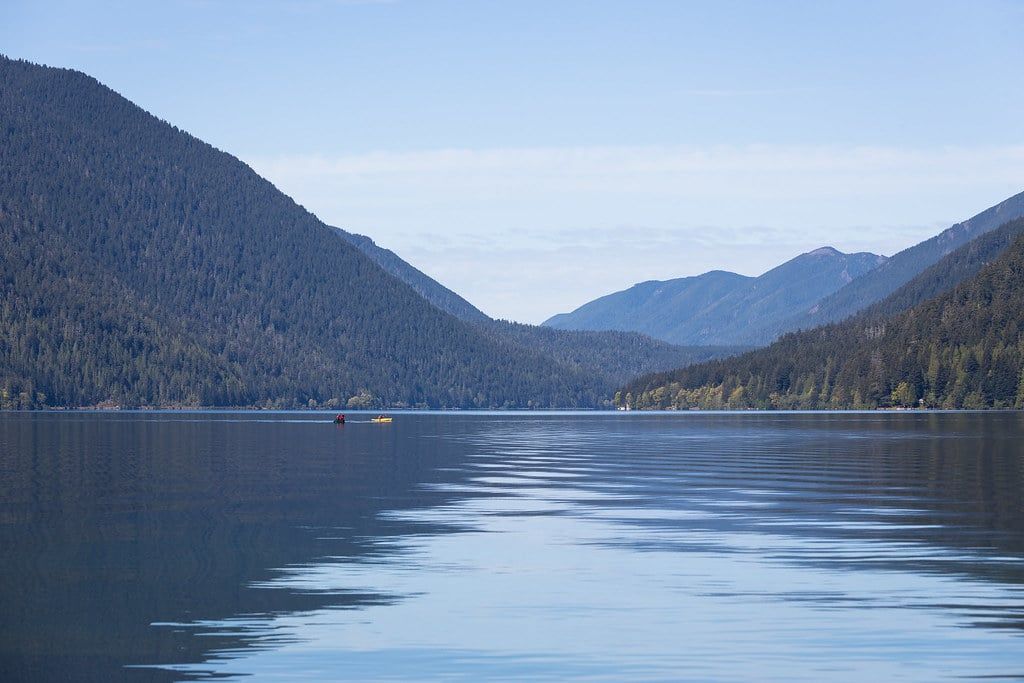
Kayaks, canoes, and paddleboards rent at Lake Crescent Lodge, Log Cabin Resort, and the Fairholme General Store, typically from late spring through early September. Go at opening — around 8:30 am — because rentals go fast and the lake is glassy in the morning. By mid-afternoon the wind picks up and the same water turns choppy enough to make a SUP paddle back into a workout. Rowboats also rent from the lodge, and boat launches sit at both the east and west ends of the lake if you bring your own craft.
Swimming is genuinely good here, with honest cold-water numbers. Surface temperatures run roughly 42–52°F in spring, 52–64°F in summer, 45–55°F in fall, and 40–45°F in winter. Even in August, that's a quick-refresh swim rather than a long soak, and the lake deepens fast off most shores. Four swim spots, in order of popularity: Devil's Punchbowl, the busy social scene reached by a 2.4-mile round-trip walk or ride from the Spruce Railroad trailhead; East Beach, the sunset-swim spot; Fairholme on the west end, quieter; and the North Shore Picnic Area, the quietest of all.
Where to Stay & Eat at Lake Crescent
You have exactly three options for sleeping at the lake — a 1916 lodge, a summer resort, and one campground — and they book out early for good reason. The good news: all three sit in different corners of the lake, so you can match the lodging to how you want to spend your days, and dinner is open to everyone whether you're staying or not.
Lake Crescent Lodge
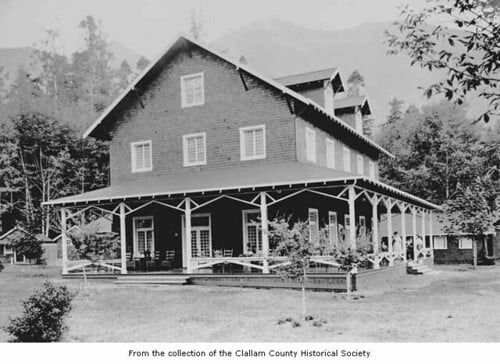
The lodge (Singer's Tavern, originally) sits at Barnes Point on Lake Crescent Road off US 101, with rooms, cottages, and the lakeside Roosevelt cabins spread along the shore. Guests get the dock, the rocking chairs on the porch, and the best sunset seat on the lake. It's open roughly late spring to early fall and closes for winter — book months ahead for summer weekends.
Log Cabin Resort and Fairholme Campground
Log Cabin Resort, on East Beach Road at the lake's east end, is the laid-back alternative: cabins, a summer-only RV campground, a casual shoreline restaurant, and a beach that catches the evening light. Fairholme Campground at the west end has 87 sites — one wheelchair accessible — with fire pits, picnic tables, potable water, animal-proof food lockers, accessible restrooms, and an RV dump station. It's beautiful but basic: no showers, and some sites require a walk from the car. Summer reservations go through Recreation.gov, and weekends fill early.
If lakeside lodging is booked, look at rentals on Lake Sutherland (just over the ridge on US 101), the Emerald Valley Inn, or base yourself in Port Angeles, 30 minutes east with far more options.
Eating at the Lake
Singer's Table at Lake Crescent Lodge takes reservations and serves non-guests — book ahead for dinner in summer. Log Cabin Resort's Shoreline Kitchen is the casual option, with burgers and beer by the water. Just outside the park, Granny's Cafe and Joyce & Co. Cafe cover breakfast and pie, and the Fairholme Store sells groceries and rents boats in summer. The Storm King Ranger Station opens in summer when staffing allows.
Picnic Areas & Quick Stops
Five official picnic areas ring the lake, all with tables: Fairholme and Bovee's Meadow on the west half, La Poel mid-lake (summer only), North Shore on the rail-trail side, and East Beach. East Beach and Bovee's Meadow have accessible vault toilets, and East Beach adds fire pits. One access note: La Poel's one-way road is steep and narrow — skip it with an RV or trailer.
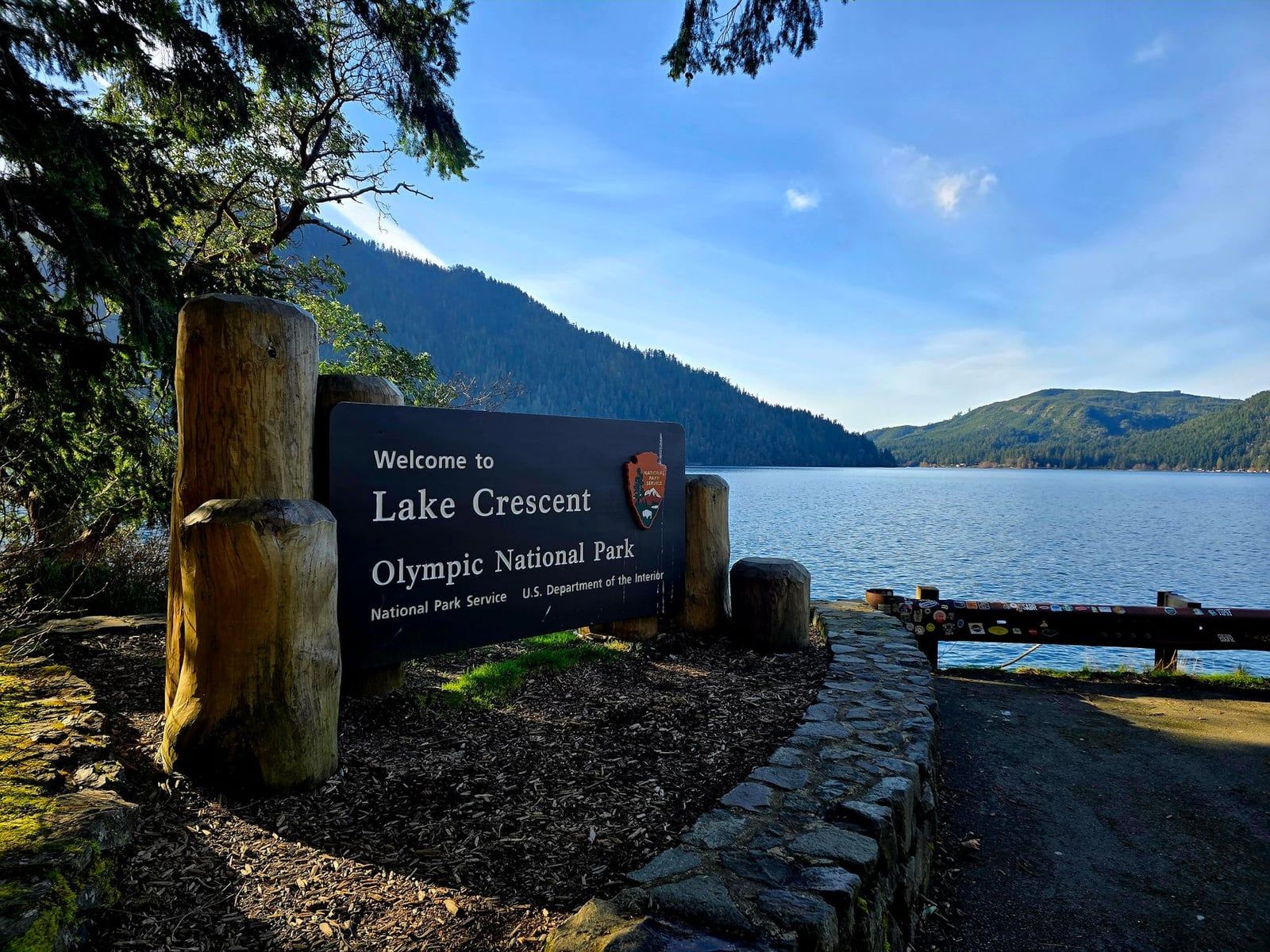
The most underrated stop isn't official at all. The Fairholme boat launch, at the west end, has giant moss-covered bigleaf maples over the water and one of the best lake views you'll get from a dock — five minutes from the parking area. For drive-by photos, the Lake Crescent welcome-sign viewpoint and the US 101 pullouts along the south shore do most of the work; the stretch west of Barnes Point is the one where people actually stop.
How Long Do You Need at Lake Crescent?
The lake's three hubs — the lodge, Log Cabin Resort, and Fairholme — sit about 15–20 minutes apart by car, so visit order matters. Coming from Port Angeles, work east to west and don't backtrack; coming from Forks, reverse it. Either way, do Marymere Falls first thing, before the lot fills.
- 1–2 hours: US 101 pullouts, Moments in Time loop, lodge porch, Fairholme boat launch.
- Half day: add Marymere Falls or the Spruce Railroad Trail, plus a swim at Devil's Punchbowl.
- Full day: kayak at opening time, hike Mount Storm King, then finish at East Beach for the sunset.
Even the short version delivers the point of the place. The full version is the best single day you can spend on the northern peninsula without a wilderness permit.
Rules, Safety & Seasonal Closures
The rules here are stricter than at most lakes, and the reasons are ecological. Pets and bicycles are banned on every trail except the Spruce Railroad Trail — pets must be on a leash no longer than 6 feet. No alcohol or glass on public beaches. Always wear a life jacket on the water; this is a cold, deep lake and the NPS says so plainly. Respect the speed limit on the winding shore road. Pack out what you pack in — there's no services staff big enough to change that math at a wilderness lake.
No permit is needed to day hike anywhere around Lake Crescent. Overnight backpacking trips need a wilderness permit, issued through the Port Angeles Wilderness Information Center, with reservations via recreation.gov. Camping fees at Fairholme run $15–24 per night depending on season.
| Facility | Open |
|---|---|
| Lake Crescent Lodge | Late spring – early fall; closed winter |
| Log Cabin Resort | Late spring – early fall; closed winter |
| Fairholme Campground | Late spring – early fall |
| Fairholme Store (groceries, boat rentals) | Summer only |
| La Poel picnic area | Summer only |
| Storm King Ranger Station | Summer, if staffing allows |
Pack for lake country, not alpine country: layers, a rain shell, and water shoes for the rocky beaches. Drones are banned everywhere in the park, launch or landing alike.
Pairing Lake Crescent with the Rest of Olympic
Lake Crescent works as a hub for the northern peninsula. The Elwha Valley and Sol Duc areas are both under a 30-minute drive — Sol Duc Falls from the lodge takes about 45 minutes and pairs perfectly with a lake morning. Hurricane Ridge is roughly an hour and ten minutes east, and the Hoh Rain Forest about an hour from the lake's west end. On the coast side, Rialto Beach is about an hour away (see our guide to the park's best beaches), and Salt Creek Recreation Area is a 16-minute drive from Log Cabin Resort via the scenic Joyce-Piedmont Road — tide pools and sea stacks without the Hoh traffic.
The classic pairing: spend your lake day at Crescent, then drive the 45 minutes to Sol Duc on a westbound travel day, hitting the falls and a soak before continuing toward the Hoh and the coast the next morning. That sequencing alone saves two hours of driving versus treating the lake as a spur.
Frequently asked questions
Can you swim in Lake Crescent?
Yes, but it's cold. Summer surface temperatures run about 52–64°F, and the lake deepens quickly. The main swim spots are East Beach, Devil's Punchbowl, Fairholme, and the North Shore Picnic Area — rinse off after swimming at East Beach, where swimmer's itch has been reported.
Why is Lake Crescent water so clear and blue?
The water contains very little nitrogen, which limits phytoplankton and algae growth. In some places you can see 60 feet down, and that clarity combined with reflected light produces the blue-green color.
How deep is Lake Crescent?
The official maximum depth is 624 feet, making it the second deepest lake in Washington after Lake Chelan.
How far is Lake Crescent from Port Angeles?
About 18 miles west of Port Angeles on US 101 — roughly a 30-minute drive, or about 45 minutes east from Forks. The road is curvy, so allow extra time in an RV.
Do I need a permit or pass to visit Lake Crescent?
Park entry costs $30 per vehicle, valid for 7 days, and an America the Beautiful pass covers it. No permit is needed for day hikes; overnight wilderness trips require a permit from the Port Angeles Wilderness Information Center.
Are dogs allowed at Lake Crescent?
Only on the Spruce Railroad Trail, on a leash no longer than 6 feet. Pets and bicycles are prohibited on all other trails around the lake. Pets are also allowed in campgrounds, picnic areas, and on roads.
What is the Lady of the Lake story?
It's a real, decades-old murder case tied to the lake. Because the water is cold, clear, and low in nutrients, it preserved the victim's remains and evidence unusually well — a piece of local true-crime lore that's now part of the lake's identity.
When is Lake Crescent Lodge open?
Generally late spring through early fall, closing for the winter. Log Cabin Resort is similar, Fairholme Campground runs late spring into early fall, and the Fairholme Store and boat rentals are summer only.