Olympic National Park protects 73 miles of wilderness coast, and twice a day the Pacific pulls back to expose one of the best tide pooling shorelines in the country. Boulders and rocky shelves that sit under crashing surf at high tide hold pools full of sea stars, anemones, and urchins an hour later. The catch, and it's a big one, is timing: show up at the wrong hour and you'll stare at nothing but wet rock.
This guide covers the six best tide pool beaches in and around the park, the tide levels that actually matter, and the safety and etiquette rules that keep the pools alive. If you're building a wider trip, our first-timer's guide to the park and our 3-day Olympic itinerary slot the coast into a full visit.
Tide Pools on the Olympic Coast: Why They're World-Class
A tide pool is seawater trapped in a rock basin when the tide recedes. What looks like a calm little puddle at low tide is a surge channel at high tide — the same crack in the rock, alternately pounded by waves and left to bake in the sun. The animals that live there, sea stars, anemones, hermit crabs, have to survive both.
Olympic's stretch of shore is one of the longest pieces of wilderness coastline in the lower 48, and the protection doesn't stop at the waterline. The offshore waters sit inside the Olympic Coast National Marine Sanctuary, flanked by three national wildlife refuges, so the intertidal zone you're standing on is managed as part of a much larger protected system. That's why the pools here stay stocked with life while comparable beaches elsewhere get picked clean.
The geology does the rest. Headlands, sea stacks, and tilted rock shelves create thousands of basins at every elevation of the beach, and the cold, nutrient-rich water of the North Pacific feeds an unusually dense crop of barnacles, mussels, and kelp. Add heavy wave action that keeps the rocks scoured and clean, and you get pools that are both crowded with animals and easy to see into.
When to Go: Tides, Times of Day, and Seasons
Tide level is the single number that decides your trip. The National Park Service says the best tidepooling happens at a minus tide, and that some lows of 3 feet "are not great" — aim for tides lower than 1 foot. Here's the full scale, pieced together from NPS and local guidance: at +1.5 ft you can still view some pools, below +1 ft is genuinely good, 0.0 ft is decent, any negative tide is really good, and -1.0 ft or lower is the good stuff, exposing zones that stay underwater most days.
For predictions, use NOAA's Tides & Currents site and pull the Destruction Island station (9444471), which the NPS links to for the Pacific coast beaches; free printed tide charts are also available at visitor centers and coastal ranger stations. Screenshot whatever you find before you leave your lodging. Cell service around La Push, Rialto, Kalaloch, and Mora is unreliable at best, and a tide chart does you no good trapped behind a dead signal bar.
Timing your arrival is simple arithmetic. Be standing at the pools about 30 minutes before the lowest tide, and add your hike time on top. For Hole in the Wall, that means leaving the Rialto Beach trailhead roughly two hours before low tide — the walk is 1.5 miles each way, about an hour. Arriving early costs you nothing; arriving late means the tide is already climbing back over the best pools while you're still hiking.
Season matters as much as the clock. March through September is the reliable window, but the character of the tides shifts through it. Spring delivers some of the best minus tides during convenient daylight hours. In summer, the lowest tides cluster near dawn, so a 6 a.m. alarm is often the price of a -2 ft morning, though long daylight (nearly 5 a.m. to 10 p.m. near the solstice) helps. Early fall remains underrated, with low tides sliding back to midday and thinner crowds on the trails. Winter belongs to storms, not tide pools. For the bigger weather picture, see our month-by-month guide to visiting Olympic.
The Best Tide Pools in Olympic National Park, Beach by Beach
These six stops are ordered roughly by ease of access, so families can stop reading when they've found their match. For a wider look at the shoreline, our guide to Olympic National Park's beaches covers swimming, camping, and sea-stack scenery beyond the tide pools.
Beach 4 (Kalaloch)
Beach 4 is the classic answer, and the easiest one to act on. A parking area just off Highway 101 south of Kalaloch puts you a few minutes' walk from a sea stack fronted by flat, creviced rock benches that hold pools at anything close to a low tide. Giant green anemones and fat purple sea urchins are the signature sightings, with sea stars and hermit crabs in the deeper crevices. The NPS names it, alongside Hole in the Wall, as one of the two most popular tide pool spots in the park. Bring the kids here first.
Ruby Beach
Ruby Beach has the easiest access of the classic beaches — a short, well-built trail from the Highway 101 parking lot down to sand laced with garnet and backed by sea stacks. The trade-off is that it's slightly less tidepool central than Beach 4: the best pools are in the rocky sections around the base of the stacks, so you'll walk a bit and pick your way across cobble. What you get in exchange is the most photogenic stretch of coast on this list, and the parking lot fills fast in summer, so come early or late. It's also the best stop if you only have an hour.
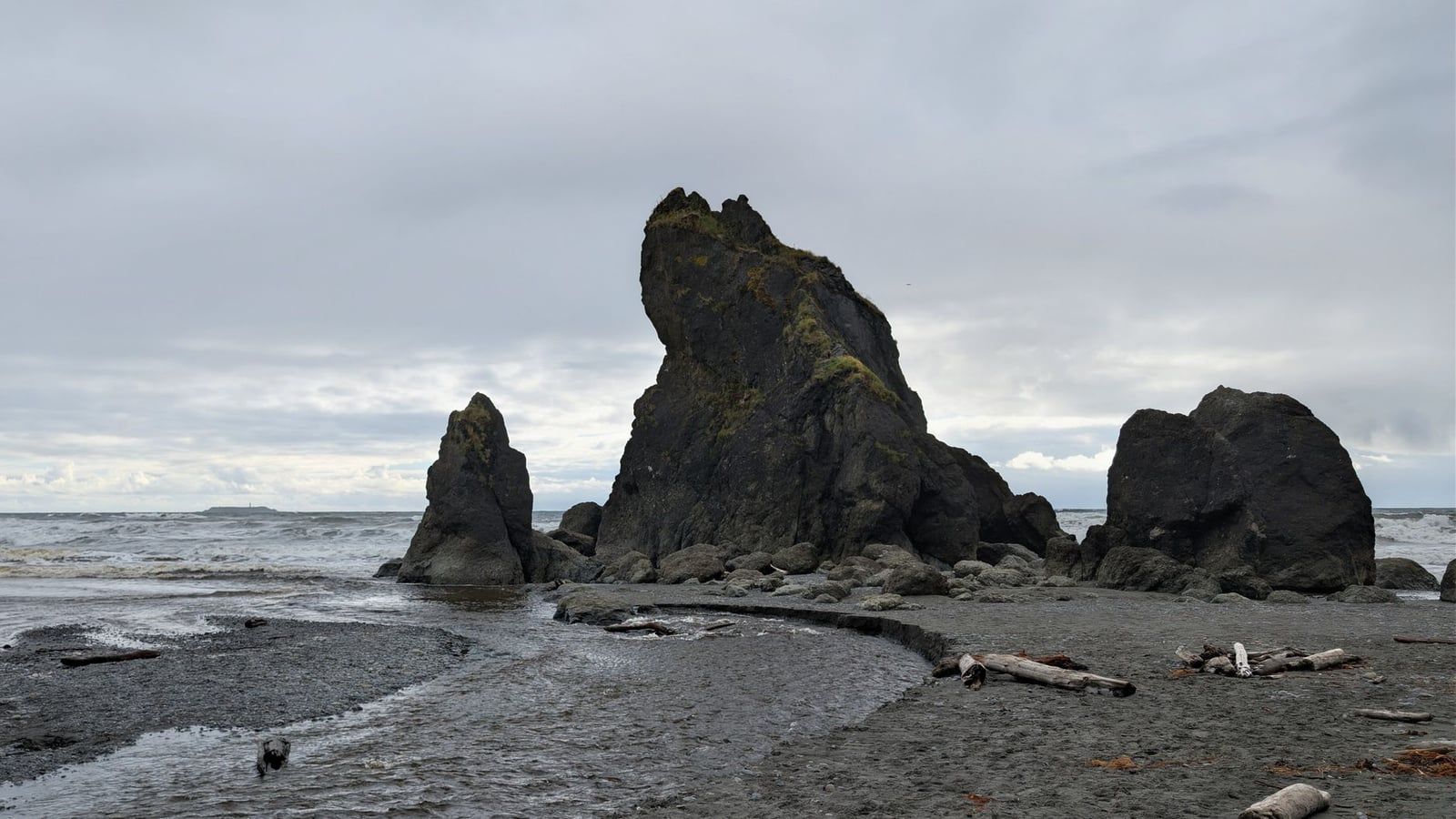
Hole-in-the-Wall (Rialto Beach)
Hole in the Wall is a natural sea arch 1.5 miles north of the Rialto Beach trailhead in the Mora area — about an hour's walk on round cobbles and sand. The pools around the arch and the headland beyond it are excellent, and the arch itself is the most dramatic backdrop for tide pooling in the park. Two rules from the NPS: don't cross through the arch once the tide covers its floor, and don't linger directly beneath it, since rockfall is a known hazard there. Time the walk for a low tide and this is the best pools-plus-hike combo on the coast.
Second Beach and Third Beach (La Push)
The La Push beaches take forest trails through salt-sprayed spruce before dropping onto sand framed by sea stacks, and the pools cluster on the rocky shelves around those stacks. Second Beach is the shorter, more popular walk; Third Beach is quieter and rougher underfoot. Both are at their best on a solid minus tide, and both work as part of a longer coastal backpacking day if you'd rather camp near the pools than day-hike to them. Arrive with time to spare — the trails add real minutes to the tide math.
Shi Shi Beach and Point of Arches
Shi Shi Beach, out on the peninsula's northwestern tip, is the wild prize. The tide pools center on Point of Arches, a line of sea stacks whose bases hold some of the richest intertidal life on the West Coast, reached by a roughly 8-mile round-trip hike that is muddy and moderately difficult. The trailhead starts on Makah Reservation land, so you'll need a Makah recreation pass in addition to park entry. Most people camp a night to catch two low tides. If you want solitude and don't mind the slog, nothing else here compares.
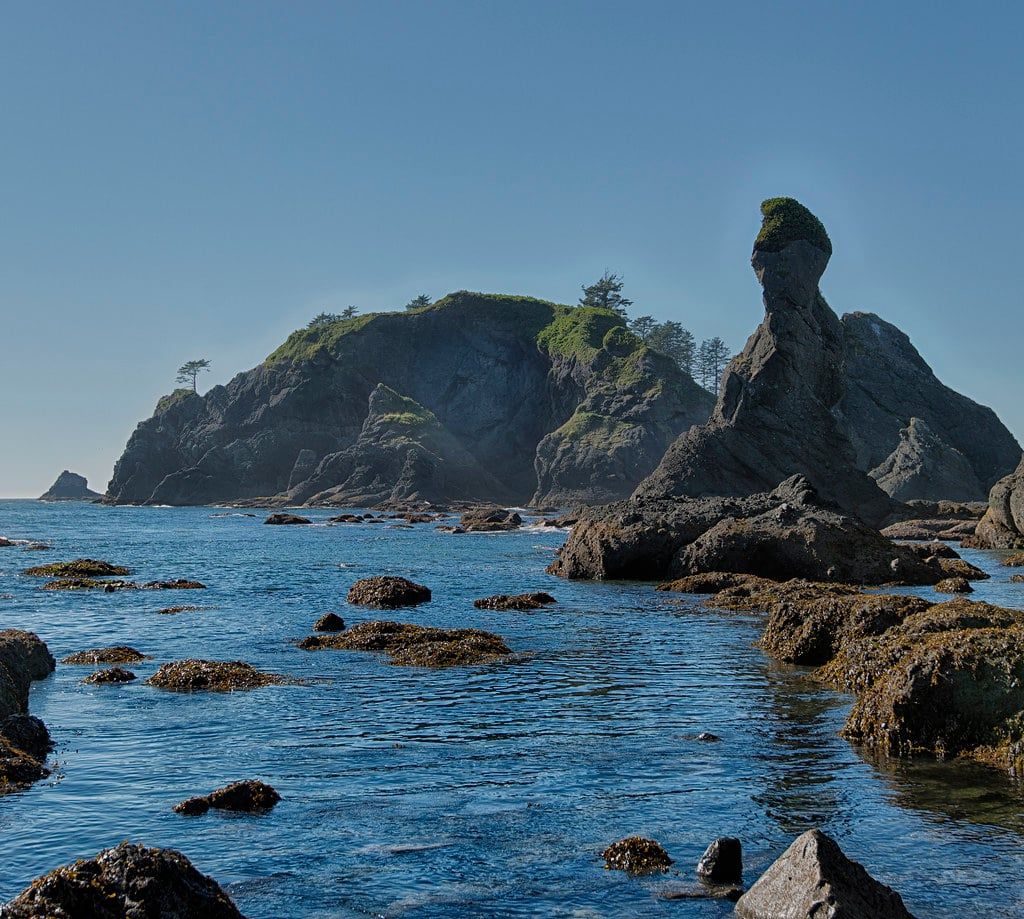
Bonus: Tongue Point (Salt Creek Recreation Area)
Tongue Point sits outside the park at Salt Creek Recreation Area, on the Strait of Juan de Fuca rather than the open Pacific, and it puts you toe-to-water in under 10 minutes from the car. The pools on its rocky tongue are deep and sheltered, which is why it offers better odds than anywhere else nearby for the two finds every tidepooler wants: an octopus and a wolf eel. It's a detour if you're based around Kalaloch or La Push, but if you're coming from Port Angeles, it's the most efficient tide pool stop on this list.
Which Beach Is Right for You?
Here's the at-a-glance version. Hike distances are round trips.
| Beach | Hike (round trip) | Access difficulty | Crowds | Best for |
|---|---|---|---|---|
| Beach 4 (Kalaloch) | Minutes from parking | Easiest reliable pools | Moderate | Families, first-timers |
| Ruby Beach | Short walk from lot | Easiest overall | Busy in summer | Photographers, quick stops |
| Hole-in-the-Wall | 3 miles, about 2 hours | Moderate beach walk | Moderate | The arch, hikers |
| Second & Third Beach | Forest trails to sand | Moderate | Lighter at Third | Sea-stack scenery, backpackers |
| Shi Shi / Point of Arches | About 8 miles | Hard and muddy | Few people | Serious tidepoolers, solitude |
| Tongue Point (Salt Creek) | Under 10 minutes | Easy but rocky | Light | Octopus odds, short visits |
One honest note on mobility: none of the true tide pool terrain is wheelchair-friendly. Rialto's beach itself is the most accessible stretch of coast, but its pools are a 3.3-mile round trip over sharp rocks and driftwood, and every other stop on this list involves uneven, slippery stone. Ruby Beach and Beach 4 are the workable options for anyone with limited mobility who still wants to see some intertidal life from the edges.
Marine Life You'll See in the Tide Pools
Start with the cast you can count on. Barnacles and mussels crust nearly every hard surface and need no tide luck at all. Add an hour of low water and you get the regulars: ochre sea stars in purple and orange, giant green anemones with their tentacles spread wide, purple sea urchins wedged in crevices, hermit crabs trundling across pool bottoms, plus rock crabs, sea snails, clams, and tubeworms. Beach 4 is the dependable spot for anemones and urchins; NOAA's sanctuary guides single out the sea stars, anemones, barnacles, and tubeworms as the coast's signature sights.
Lower tides buy you rarer company. Tide pool sculpins and pricklebacks hide under ledges, brittle stars tuck their serpentine arms into cracks, and sand dollars and sea cucumbers appear in the sandy-bottom pools. Then there are the lottery tickets: wolf eels and, at a few sheltered spots, an octopus — which is exactly what Tongue Point is known for. Nobody can promise either one. That's what makes finding them the story you tell afterward.
Seeing any of this is a technique problem as much as a timing problem. Look into still, clear pools rather than surging ones. Check cracks and crevices, where the shy animals wait out the low tide. Watch for movement rather than color — a sculpin is the color of the rock it's sitting on, but its fins twitch. Move slowly, crouch at pool edges, and give each basin a full minute before declaring it empty. Kids, incidentally, are often the best spotters in the group; their eyes are closer to the water. For the bigger animals offshore, from sea otters to gray whales, our wildlife guide to Olympic covers where and when to look.
Tide Pool Safety: Waves, Tides, and Terrain
The ocean is the hazard that can kill you, so start there. Sneaker waves — walls of water that arrive without warning on otherwise calm days — sweep people off rocks every year on this coast, so never turn your back on the surf and stay off beach logs the waves can lift. Watch the returning tide, too: the water that opened the pools will close them, and several coastal points, including some headlands, are only passable at lower tides. Know your exit route before you commit to one. Storms and strong winds push tides higher than the chart predicts; if big surf is forecast, save tide pooling for another day.
The rocks themselves are the other hazard. Algae and seaweed make the stones extremely slick, and the surface is carpeted with animals you shouldn't be crushing anyway. Test each footing before you commit your weight, and never leap from rock to rock — the NPS rule is to keep at least one foot on the ground at all times. Wear sturdy closed-toe shoes you don't mind getting soaked.
Two special cases. At Hole in the Wall, don't cross through the arch once the tide covers its floor, and don't stand beneath it: rocks fall from it, and if you hear cracking or falling rock, cover your head and move away fast. And leave the dog in the car or on the sand — sharp stone, barnacle shells, and mussel beds cut paws badly enough to cause infection, which is why the NPS says no dogs on tidal rocks. Keep children within arm's reach the whole time; a pool that's knee-deep at 10 a.m. can be waist-deep by 10:40.
Tide Pool Etiquette: How to Look Without Harming
The pools stay this good only if visitors follow a handful of rules, and they're not optional — the intertidal animals here survive being drowned and battered twice a day; they don't survive being collected. Walk on sand or bare rock, choosing footholds that avoid crushing barnacles, mussels, and anemones, which colonize nearly every surface. Take nothing home: no prying animals off rocks, no collecting shells or creatures, not even for bait. Everything in the park is protected.
If you touch, use NOAA's touch test: touch an animal gently, and if it resists or clings tighter, stop. Forcing a sea star or anemone off its spot can tear its feet or crush its internal organs. If you lift a rock to see what's underneath, put it back exactly as you found it — the underside is someone's roof. Touch gently if at all, take only pictures, and leave nothing behind.
Two small acts that add up: bring a bag and pick up trash you find on the way out, and use reef-safe sunscreen, since ordinary formulas wash off into the pools and harm the animals living there.
What to Pack for a Tide Pooling Trip
The Olympic coast runs cold, wet, and foggy even when it's warm and sunny inland, so pack for a different country than the one you drove through. The checklist:
- Closed-toe water shoes, grippy hiking sandals, or old trail sneakers — never flip-flops or bare feet
- Layers plus a rain shell, even in August
- Offline tide-chart screenshots on your phone
- A waterproof phone sleeve or camera protection
- Snacks and water
- A trash bag for your garbage and any you find
Waterproof hiking boots work too, and binoculars are worth the weight if you also want to watch seabirds and seals from the headlands. Skip the bucket and net entirely — the no-collecting rule applies to gear as much as to hands.
Guided and Ranger-Led Tide Pooling Options
You don't need a guide. Most visitors go self-guided with a tide chart and do fine, and if you're comfortable reading the tide table and doing the arrival math, that's the cheapest and most flexible way to do it. If you'd rather have someone else handle the logistics, our self-guided driving tours route you along the coast with the timing built in.
Ranger-led tide pool excursions run seasonally and add real education value — rangers know which pool holds the wolf eel this week. Check the schedules at the Kalaloch Ranger Station (360-962-2283) or the Mora Ranger Station (360-374-5460), and call ahead for current conditions in any case. Commercial guides earn their fee mainly on timing: park tide pools are visible for only a few hours a day from roughly late April to early September, and guided outfits schedule across multiple mornings to hit the lowest tides. That matters if your coast time is short or your trip lands in a week with awkward dawn lows.
Tide Pools in Olympic National Park: FAQs
The questions people actually ask, answered from the official guidance above.
Frequently asked questions
When is the best time to see tide pools in Olympic National Park?
At low tide — the lower the better. Pools are viewable up to about +1.5 ft, good below +1 ft, and best at minus tides of -1.0 ft or lower. Be on the rocks about 30 minutes before the lowest tide, plus your hike time.
Which beach has the best tide pools in Olympic National Park?
The NPS names Kalaloch's Beach 4 and Mora's Hole in the Wall as the most popular. Beach 4 is hard to beat for ease; Shi Shi Beach and Point of Arches have the wildest pools; Ruby Beach is the easiest to reach.
What animals will I see in the tide pools?
Count on ochre sea stars, giant green anemones, purple sea urchins, mussels, barnacles, and hermit crabs. On lower tides you may find sculpins, pricklebacks, and brittle stars, and with luck a wolf eel or octopus.
Can you touch the animals in the tide pools?
Gently, and only if the animal doesn't resist — that's NOAA's touch test. Never pry or force anything off a rock, which can tear its feet or crush its organs, and never take anything home.
Are dogs allowed at the tide pools?
Not on the tidal rocks. Sharp stone, barnacles, and mussel shells cut paws and can cause infection, per the NPS. Leashed dogs are fine on some beach sand, like the Kalaloch area, but keep them off the rocks.
Do I need a guide, or can I explore tide pools on my own?
You can go on your own with a tide chart — most visitors do. Ranger-led excursions add education and safety, and commercial guides handle the tricky low-tide timing across multiple mornings.
What should I wear for tide pooling?
Closed-toe shoes with real grip that you don't mind getting wet: water shoes, grippy hiking sandals, or old trail sneakers. Never flip-flops or bare feet on algae-covered rocks, and bring layers — the coast stays cold.
What time of year are minus tides during the day?
Spring delivers some of the best daylight minus tides; in summer the lowest tides cluster near dawn. June and July often have the most convenient viewing windows, and the season overall runs March through September.